
The open rose fades,
and time’s spiral turns
Nothing stands alone or still.

Creation evolved us,
who discovered rhythms,
describing creation.

The first realm is creation itself
from quarks to earth to cosmos.
Why is there space?
we ask the cosmos.
Why should there be time?

The second world evolved in time.
Our awareness has
no stars, quarks, or quanta.
Could we be the stuff
the cosmos expected?
Why am I conscious?
Whose presence is this?

A third world maps the first
The mathematical forms
that describe creation
are created within our consciousness
and are symmetries of beauty
and rhythms of grace.
The circle is complete;
this trinity flows.

Are there other trinities
calling to us
from the depth
of trust and presence?

We remember that
the rose fades;
time’s spiral turns;
and nothing stands
alone or still.
Since the beginning
God opens, there is light;
and the Spirit flows.

Now – is at peace.
Here – is the place where love flows.
This – is Your Presence.
Reflections and Connexions
While “open rose” is its own metaphor, it’s also an acknowledgement to Roger Penrose, the originator of what he called the 3 worlds metaphor. In years since 2017 when I first wrote a draft of this poem, I have revised it several times. I found that the Cappadocian Fathers of the 4th Century developed a similar theology of Trinity involving the concept of kenosis, self-emptying. In their theology the love of the Father is emptied into Christ, Christ’s love is emptied into the Spirit, and the Spirit empties her love into the Father. However, we don’t really fathom the Trinity, but only approach it through metaphor. These metaphors are offered to help us remain humble in the presence of an unfathomable God.
In more recent times, Christian theologians have recognized trinitarian concepts in other religions. The Trinity can be seen in the first three verses of Genesis as summarized in this haiku – In the beginning / God created, the Spirit / hovered there was light. Consider also that Christian theologian Raimon Panikkar offers a triadic structure of Reality combining divine, human, and cosmic elements. He points out that none of these “parts” exist separately but only in their interdependence. This is similar to the internal structure of every proton and neutron in the nucleus of every atom, being composed of three interdependent quarks. There are trinities everywhere. In the last lines of the poem are the three words Thomas Merton used in his briefest spiritual instruction to the novices in the Abbey of Gethsemani – Now / Here / This.
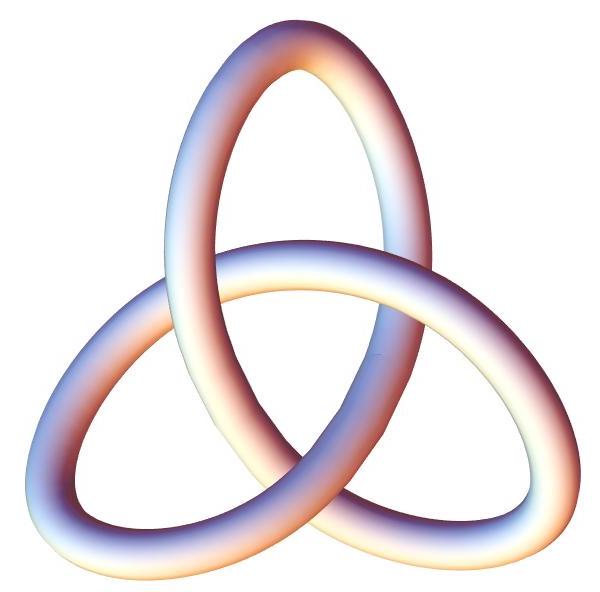
One of my new contributions to this edition of the Open Rose for Trinity Sunday poem is the trefoil knot in its geometric construction with the Mathematica program. It is the mathematically simplest knot, other than the circle. Such knots were even used in Celtic art in pre-Christian times. Even now there are holy wells all over Ireland. I offer this trefoil design as a three-fold path around an Irish well. I wanted to include, but cannot, a beginning page of John’s Gospel from the Book of Kells, as part of this poem, with its many 3-fold designs, its portrait of John the Evangelist, and the words “In the beginning.” Instead I offer the photograph of the rose that was taken by my mother, Virginia Hennessy Freal. As TS Eliot has written, “In my end is my beginning.”
Like Love, God is a verb, and we are part of that expression. Let me be open to the flow and fullness of love, to the river of grace.
Leave a Reply