
I was a Panther in high school because that was our school’s mascot. But that’s not what this is about.
In early 1960s the nightly news brought reports of freedom rides, sit ins, boycotts, marches, civil rights demonstrations, and voter registration. In high aschool I thought if I had been a year or two older, I would want to spend the summer in the South registering black voters in 1964 or 1965. Of course, then I was quite unaware of the danger, the cost, or the heat – or the culture. Our town had only one black family. In high school the only black person I’d ever talked to was a member of another basketball team. It seemed important to me to be able to do something for social justice and about racial injustice as I entered college. When I started at Stanford, it was only slightly less white than my hometown. All the black students that I knew about were there on athletic scholarships, except for a handful of young women.
One of the black students that I knew from the freshman football team was a roommate for a while our second year at Stanford. He was the first black person to become a member of Beta Chi. His membership had been made possible 4 years earlier when the Beta Chi chapter of Sigma Nu had left the national organization over its racial exclusion policy. The first black person I really got to know was the cook for our fraternity, Janie Lee Dorsey. I was a kitchen helper and server at the fraternity to help defray some of the expenses for room and board. She was a heart of gold person who seemed to be able to take time to talk to all of us.
She was a large person at six feet two. She also had a real gold heart in one of her front teeth. She grew up in Louisiana and played high school basketball there in the late 1940s. It was unusual then for any high school or college to sponsor sports for women. In the 1970s when collegiate sports for women began to happen everywhere, I noticed there were always several teams from Louisiana that were always among the best in the nation. Janie said that the high point of her week was singing in her church choir, but she would only sing occasionally when working in the kitchen. She was always very accommodating when a few extra guests would show up for dinner.
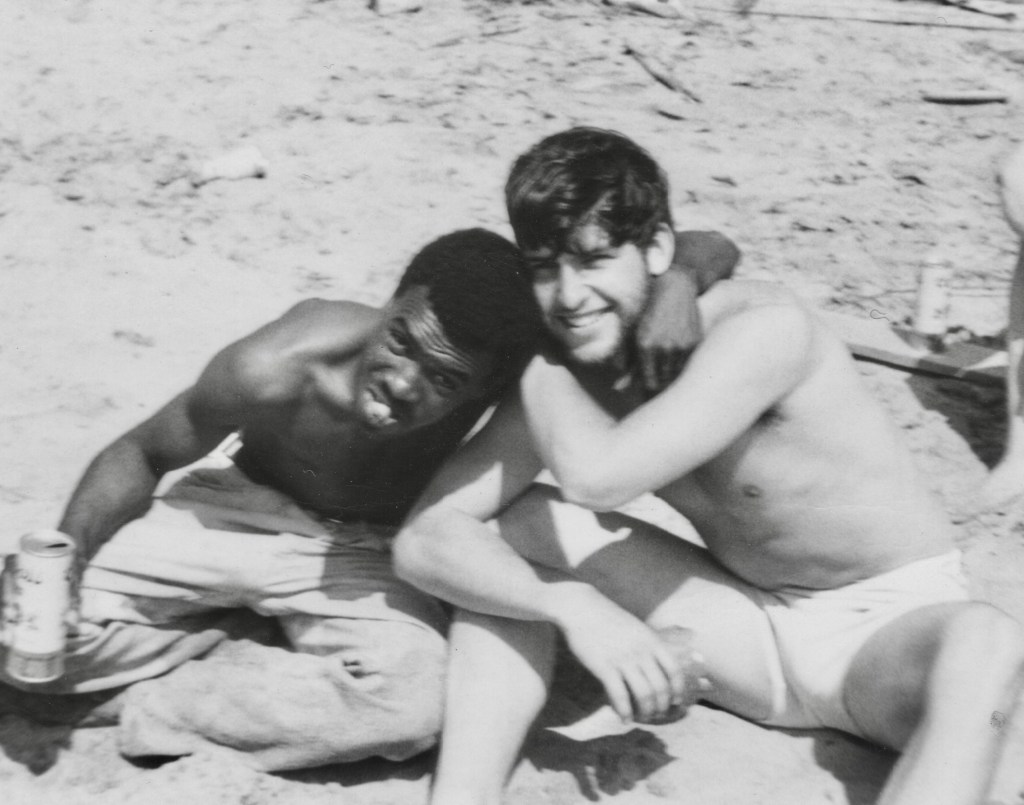
During the year I lived at Beta Chi interesting people from outside the Stanford community would be invited by someone to come to our table for dinner. In the winter and spring when the house became less crowded, they were often invited to spend the night too. In the fall jazz saxophonist John Coltrane played in living room and stayed for dinner. Blues guitarist Buddy Guy and his band gave two concerts in the dining room, one in February and one in May. Holy Hubert who preached hell fire on college campuses all over the country also shared a meal with us. The visitor that I remember best was Louis “Lefty” Bryant, a civil rights worker who worked in Milwaukee with the NAACP and Father James Groppi. Lefty showed up the week before the first Buddy Guy concert. He said Fr. Groppi had sent him to the west Coast to raise funds for the NAACP, but from what he told us about demonstrations and getting beat up by police, I think Lefty probably sustained a concussion. Fr. Groppi probably sent him away to recover. Lefty also told me about demonstration tactics used by the NAACP marchers in Milwaukee. He really liked the Buddy Guy concert and the trip we made to the beach the next day. He deputized me to be his chief fund raiser on campus. We held out a coffee can and held a sign that said “Contribute to the NAACP” between classes on the Stanford campus. We raised only $10-20 in two days. With the $10 I gave him Lefty had enough for a bus ticket to return to Milwaukee. I never got a Freedom Summer, but I had a brief Freedom winter in 1967.
One of the graduation requirements at Stanford was to take two colloquia. These were small seminars. The first one I took during my junior year had a faculty sponsor, but a pair of basketball players – one black and one white – actually ran the seminar. They had gone to rival high schools across the bay in Oakland and were in their third year as the starting backcourt for Stanford. The friendship of Art Harris and Gary Petersmeyer was very apparent. We read The Autobiography of Malcolm X and Manchild in the Promised Land and discussed these in class. It was especially good to get Art’s perspective on these two autobiographies about growing up in an urban ghetto. Art was drafted by the Seattle Supersonics and played a few years of professional basketball. I think Gary went on to law school.
That winter my friend Richard Slavich told me that there was an intramural team representing the Black Student Union at was playing interesting basketball in Stanford’s intramural league. We found out when their next game was and went one February afternoon to watch. We got there just as the previous game was finishing. The referee – there was only one – was getting badgered by both teams. When that game was over, he continued to get harassed by the losers. He was supposed to continue refereeing the game between the BSU and a fraternity team from Sigma Alpha Epsilon. I think the referee wanted no part of the next contest and left only his whistle for whoever might be foolish enough to follow in his footsteps. Richard and I recognized that there were many scholarship athletes from other sports on both teams. When the teams realized that the referee had left, they along with the clock operator asked the crowd of about 25-30 spectators if anyone wanted the job. Although Richard quietly tried to discourage me from volunteering, I said I would do the job until someone official showed up.
I tossed the ball high enough and straight enough for a fair tip off, and the game was under way. The fraternity team from Sigma Alpha Epsilon got out to an early lead that was as much as 10 points. The BSU narrowed the gap a little by halftime but did not shoot well from the outside in the first half. In the second half like the SAEs, the BSU started driving to the basket and making a greater attempt to stop their opponents from doing so. For me that meant more decisions as to whether fouls were blocks or charges. I think fouls evened out and the players on the court really decided the outcome. In the final minutes the BSU got their first lead. The SAEs made a basket to retake the lead, but I called a charge on the player who made the basket and waved off the goal. The BSU scored the next time down increasing their lead to three. Again the SAEs scored on a baseline drive to the basket, but I saw the player step out of bounds on the way. No basket. The SAEs never got any closer. I knew some of the players on both teams by name or reputation. The three Carrigan brothers from the SAEs followed me out of the gym. Andy or Mike Carrigan, both scholarship football players, asked me how I could make an out of bounds call from 30 feet away on their brother Casey. (Casey was at Stanford on a track scholarship) I said it was easy because he was almost a foot out. At this point all 3 brothers said they wanted to fight me, but they would leave the fighting to Casey because he was more nearly my size. At this point my friend Richard caught up with me and said he thought fighting was not a good idea. We walked away, and the brothers didn’t follow. (Rich was smaller in stature than I was, but I credit him with the first Jedi mind trick.) I developed a new respect for referees but didn’t referee any more while at Stanford.
In the mid 1960s the movement for civil rights and voting rights broadened to include economic justice and an end to police brutality. Calls for integration changed to calls for black power. The centers of activity moved from the rural South to the cities of the North and West. New leaders of the movement emerged. We all saw changes in big ways and small. When Buddy Guy gave his winter concert at Beta Chi, he had a conk, a process that straightened his curly hair that had been especially popular among black entertainers. When he was back in the spring, he had his natural curly hair. By 1967, few self-respecting black musicians would want to have “white” hair, except perhaps Little Richard and James Brown. When Richard and I went to the BSU intramural game in 1968 we knew several of the players, but none wanted to acknowledge their white acquaintances among their peers. When Martin Luther King was assassinated two months later, black communities around the country erupted in violence. Perhaps nonviolence would not be the only path to social change.
In Oakland, California in late 1966, Bobby Seale and Huey Newton founded the Black Panther Party. Their parents’ generation had migrated from the South, moving to the cities of the North and West only to find new forms of urban poverty and racism. After a young black man had been killed by police across the Bay in San Francisco, the founding Panthers wanted to do something about the racist policemen who patrolled their community. They bought copies of Chairman Mao’s Red Book and sold them to people in Berkeley at three times the price. With the proceeds they bought guns. With the guns they patrolled the streets of their neighborhood in Oakland in parallel with the police, offering protection from the police for any mothers or brothers in need. Carrying guns like this was legal. They got other young men to join them. Eldridge Cleaver joined the Panthers and became their Minister of Information. He ran their community newspaper. His book Soul on Ice was published just a week before King was assassinated. It became a national best seller. In the course of separate shootouts with police both Newton and Cleaver were wounded. A policeman was killed in the shootout where Newton had been wounded, and he was sent to jail for manslaughter. A “Free Huey” campaign ensued. Cleaver spent some time in jail over his incident, but there was not enough evidence to charge him with anything. The local authorities and the FBI tried to return Cleaver to prison on his previous conviction of rape. (Read about that crime and Cleaver’s trial and appeal in Soul on Ice.) But before the poice could arrest him, Cleaver left the country for Cuba first and then Algeria. Upon his return to the country someone in student government at Stanford got him to come to Stanford to speak.
My Shakespeare professor, who had been my favorite teacher at Stanford, was offering a senior seminar on autobiography. We were to read a book a week and be ready for a two hour discussion. There were about 15 students in the class. Even though the schedule was already full, a couple of my classmates wanted the class to read Cleaver’s Soul on Ice. I hadn’t heard of Cleaver before but I agreed with my classmates suggestion that we have a extra session to squeeze in the extra book. We had just finished the extra session on Soul on Ice when I found out that Cleaver was going to speak on campus, the next day in fact.
I got to Memorial Auditorium, the largest indoor venue on campus, about ten minutes before the scheduled talk. The doors to the auditorium were closed and locked. Some students were setting up speakers so that those outside could listen to the speech. Rich Fields, a friend who I hadn’t seen a while, was there. We realized were both dressed alike, jeans, blue work shirts, and denim jackets – the standard costume for white student radicals – except Rich was wearing a “Free Huey” button. We both agreed that it was a disappointment not to be able to get in. I suggested that we try to go around the back of the auditorium and see if a door was open. When we got there, three cars were pulling up and 5 or 6 people were coming out of one of the doors of the auditorium. Half a dozen large black men got out of the cars. They were all dressed black leather jackets and black berets. In the confusion and tenseness of the moment each group must have thought that Rich and I belonged to the other. We all went through a back door into the auditorium. Three of the Panthers immediately stationed themselves at the back of the stage, assuming the military “at ease” stance. I was hoping to sneak down to find a chair in the auditorium but there were none. I found myself at the right wing of the stage and assumed the “at ease” stance. I motioned for Rich to do the same on the opposite side. Eldridge Cleaver now had five body guards. He spoke for an hour, starting with black power and power to the people. He told us, “You’re either part of the problem or you’re part of the solution.” He spoke about freeing Huey Newton from prison – his conviction was eventually overturned. He spoke about the Panther’s ten point program for land, bread, housing, education, clothing, justice, peace and freedom for captive black men and an end to police brutality and murder. He spoke about how white men could support the program. He also spoke about how white women – in the manner of their Ancient Greek counterparts in Aristophanes’ Lysistrata – should withhold their sexual favors from any men who did not support the Panthers’ program. Cleaver and the other Panthers were gone very quickly after the speech finished. I didn’t know it then but Cleaver was probably still on the lam and needed to be gone to stay a step ahead of the authorities.
Rich and I caught up with each other outside the auditorium. We had a good laugh, but I told him didn’t like the guns and violence. He thought it might be necessary to at least have the threat. He became a civil rights lawyer and worked for a Poverty Law Center in Tennessee. I never saw Rich Fields again but reading his obit found that he had become a kingpin in Memphis politics. I didn’t think about the Panthers again until I’d moved to Seattle and was starting an alternative school for the kids in a housing project that were dropping out or getting kicked out of the regular high schools. (The West Seattle Street Academy is another story.) One sunny morning there were two Panthers on the Ave who were hollering, “Free breakfasts for kids.” They were holding out the same kind of coffee can that I had held out for Lefty Bryant. I contributed but wondered not about what had happened to Cleaver but what had happened to Lefty who was my inspiration for doing something like I was about to undertake for student dropouts.
I put this story to this point on my old blog in early 2018. Lefty’s daughter found it and emailed me to set up a conversation by phone. Later when we had that phone call I found out about what happened to Lefty. He said he was the youngest child of a large family in South Carolina and was told by his parents to leave home because of something he had done at age 17. (No one knows now, but what I think is that it wasn’t serious but could be life threatening, like talking to a white girl.) Some of Lefty’s work in civil rights in South Carolina was the subject of the PBS documentary series We’ll Meet Again. He was the leader of a small group of locals and young people from other places who tried to integrate local restaurants that were just recently supposed to be open to all because of the Civil Rights Act. Sometimes the restaurant owner would just close the restaurant. Lefty’s civil rights group would picket for awhile then return to a local NAACP office in another town to find places to eat and sleep. In a few cases they successfully integrated small town restaurants. One day after a couple hours of picketing, a group of local enforcers followed the civil rights group out of town and forced them off the road. The enforcers had guns and threatened several members of the civil rights group. Lefty was never afraid to talk about what was right, and probably for that reason none of the other members of the group were hurt though Lefty was severly beaten. The picture in the documentary that stays with me is of Lefty face-down in a rural South Carolina ditch.v
Lefty left South Carolina before too long, went to the Milwaukee NAACP office and there met Father James Groppi who had begun work on stopping the practice of red lining, not letting black people buy property in most neighborhoods. Lefty helped Father Groppi organize and run nonviolent marches in Milwaukee. Large crowds would start in the black neighborhood but then march to other ethnic neighborhoods, stirring up those communities as well. After a few weeks of this the police grew tired of following several crowds of people around Milwaukee wearing riot gear in the summer sun. There were eventually meetings with city officials and businesses and the practice of red lining began to be abandoned. As I guessed earlier in this story, Lefty’s place at the front of the marches made it likely that he would have been clubbed by police.
I already wrote about my short time hanging out with Lefty at Stanford, but I learned from his daughters about Lefty’s work before they were born in the Los Angeles area. By 1969, Lefty found himself around the campus of UC Santa Barbara near the adjacent community of Isla Vista. He joined the diverse and loosely organized student group that was demonstrating against the Vietnam War, the Bank of America’s illegal financial support of apartheid in South Africa, and red lining in the local community. I think Lefty was attracted to the issue of red lining and hoped nonviolent tactics similar to those in Milwaukee would lead the end of those real estate practices. The police knew about Lefty’s past in the NAACP and considered him a trouble maker. After a few demonstrations Lefty was one of the people arrested. Some days later the demonstrations turned violent, and on an evening in February of 1970, the Bank of America branch in Isla Vista was fire bombed and went up in flames, though no one was hurt. As the press inquired with the local police concerning what they knew about the fire bombing, Lefty’s name came up. The police spokesman told the press they going to arrest Lefty when they found him. He didn’t know that Lefty was in jail before, during, and after the bombing. With Lefty’s commitment to nonviolent leadership, the irony is that if he had not been in jail he might have stopped the group that burned the bank. What became known as the Isla Vista Riots continued into the spring and the local police as well as the Los Angeles county tactical squad came out frequently, Governor Reagan became involved, and a UCSB student was killed by police. I think Lefty stepped away, realizing that the civil rights era was over.
Lefty stayed in the LA area and married soon. The couple had two daughters. Lefty became the stay-at-home parent. He was very involved in his children’s education. It was a time when sports for girls and women blossomed, and Lefty became a volunteer basketball coach for his daughters’ teams and others. At the same time he began volunteering to speak in middle and high school classes about the civil rights movement. His older daughter told me this was an important part of his life for many years.
I was able to tell her about his times in Milwaukee and at Stanford. I sent her this picture of Lefty and me from 1967. She was grateful for the more complete story of her father’s life. Louis “Lefty” Bryant died in 2008.
Leave a Reply